
Profitable but No Cash Flow: Why It Happens and How to Fix It
A business can be profitable but have no cash flow because profit is recorded when revenue is earned, while cash moves only when a customer actually pays. Under accrual accounting, an invoice sent is profit booked. If that invoice carries net-60 terms, the money arrives two months later. Payroll does not wait two months.
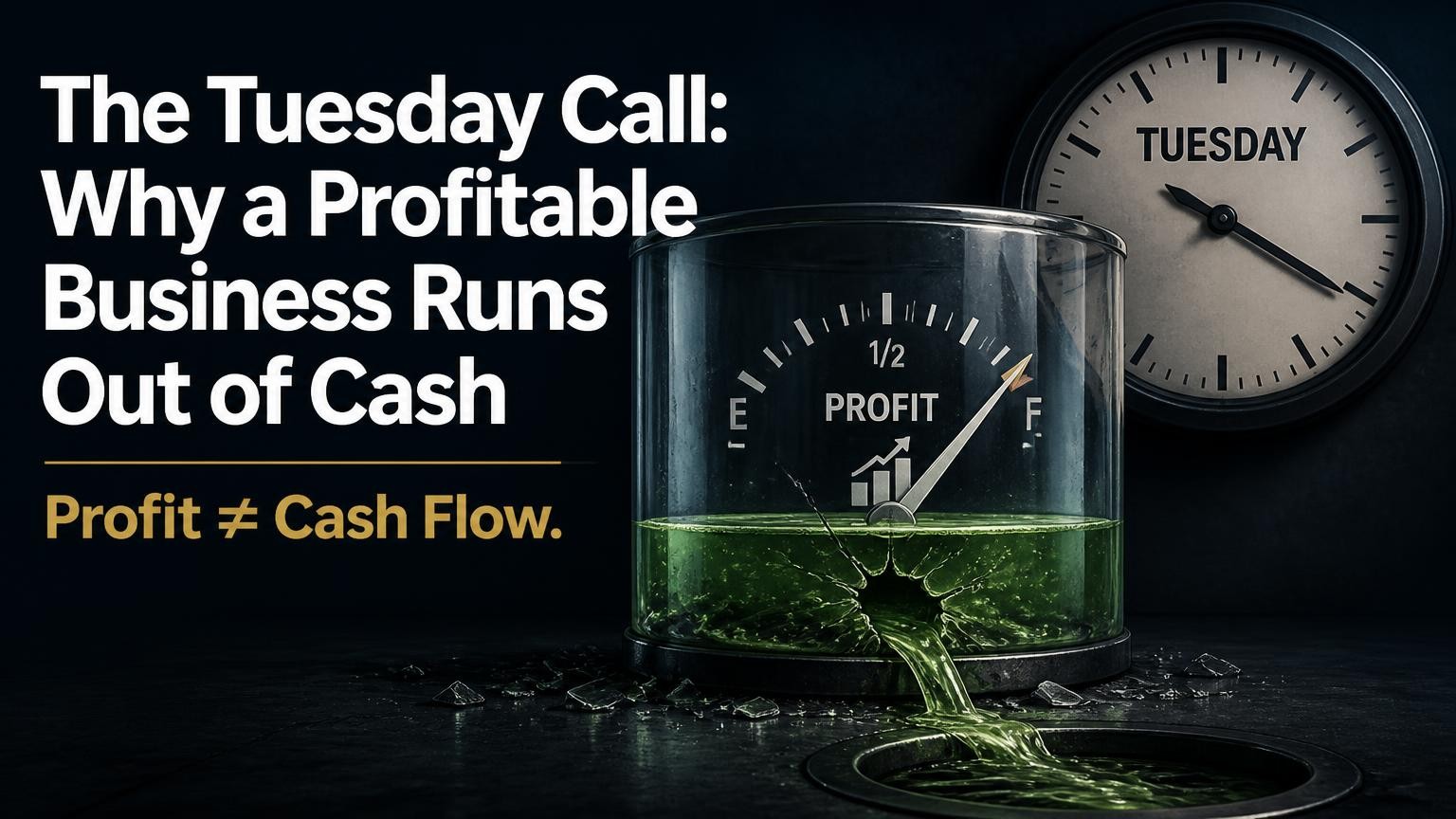
The Tuesday Call: Why a Profitable Business Runs Out of Cash
THE SHORT ANSWER
A business can be profitable but have no cash flow because profit is recorded when revenue is earned, while cash moves only when a customer actually pays. Under accrual accounting, an invoice sent is profit booked. If that invoice carries net-60 terms, the money arrives two months later. Payroll does not wait two months.
The call came on a Tuesday. It almost always does.
The CEO on the line had $47,000 in the bank and payroll due Friday. He was not calling for advice. He was calling because he had run out of options and needed someone to tell him what to do next.
He had a profitable company. That part matters. His income statement looked fine. His accountant had told him things were going well. He had revenue, he had customers, and he had twenty-three people counting on direct deposits to hit at midnight on Thursday.
And he had $47,000.
I have taken a version of that call for thirty years, from founders across dozens of industries. People who built real businesses, hired real people, and made real decisions, and still found themselves on a Tuesday staring at a number that did not add up.
They were not careless. They were missing one document.
How can a company be profitable and still not make payroll?
Profit and cash measure two different events. Profit is an accounting event. Cash is a banking event. They follow different rules and they arrive on different days.
Here is what that looks like inside a real quarter.
A consulting firm had crossed $5 million in revenue, was growing 42% year over year, and had posted a profit every quarter since its second year in business. Three enterprise contracts were in active delivery. All three clients were on net-60 terms, standard for enterprise work and described as non-negotiable when the deals were signed.
Invoices went out July 1. Expected cash arrival was early September.
July payroll was $186,000. Benefits and overhead added $44,000. A subcontractor billed $67,000. Total cash out in July was $297,000. Cash collected in July was $94,000.
By the end of August, the founders pulled the receivables report. It showed $612,000 outstanding. All of it legitimate. All of it collectible. None of it in the bank. Payroll was in 18 days.
The quarter closed at $194,000 in profit, the best in company history. The lowest cash point inside that same quarter was $91,000, against a monthly burn of $311,000.
They were 18 days and one slow-paying client away from missing payroll in their best quarter ever.
The income statement recorded the victory. The bank account recorded the truth.
What is the difference between profit and cash flow?
Profit is what your accountant reports. Cash flow is what your bank reflects. Profit is recorded the moment a transaction is recognized, whether or not money has changed hands. Cash flow moves only when dollars actually transfer between accounts.
That has a practical consequence most owners learn the expensive way. Your income statement can describe a strong month while your operating account is losing ground. Both documents are correct. Only one of them writes checks.
Revenue is a promise. Cash is a fact. The distance between the promise and the fact is where profitable companies quietly run out of money.
Why does this happen to good operators?
It is not a discipline problem and it is not an intelligence problem. It is a visibility problem.
Most owners build a company because they are good at something. Selling, building, serving, producing, leading. Very few start with a framework for weekly cash review, receivables aging, and working-capital timing. They were told to trust the accountant and focus on revenue.
That advice is not wrong. It is incomplete. The result is a leader making executive-level decisions on entry-level cash information, and then blaming themselves when the picture does not add up.
What are the warning signs before it becomes a crisis?
In nearly every cash crisis I have walked into, the problem was not new. It had been building for months and it was visible in the numbers the whole time. Four signals show up first.
Receivables growing faster than revenue. If revenue is up 31% and receivables are up 47%, the difference is cash you earned and have not collected.
Days sales outstanding climbing quarter over quarter. Five days of movement on a meaningful revenue base is worth real money, and it is worth knowing what days sales outstanding is costing you before the bank asks.
Operating cash flow below 70% of net income. When profit stops converting to cash at that rate, something in the operating cycle is absorbing it.
A revolving credit line that never returns to zero. If you cannot remember the last time the line was at zero, it is not a revolving facility anymore. It is term debt wearing a revolver's name.
What should an owner do first?
Three numbers, every Monday morning, before anything else.
Current available cash, net of reserves and committed outflows. Not the bank balance. The number you could actually deploy today.
Receivables due in the next 14 days, confirmed collectible rather than merely outstanding.
Payables due in the next 14 days, everything owed, whether or not you plan to pay on time.
The gap between the second number and the third is your near-term cash exposure. If it turns negative, you are in a timing crunch, and you want to know that before payroll week rather than during it.
That is the ten-minute version. The full version is a rolling 13-week cash flow forecast, which is where most of our engagements begin.
When is it time to bring in a fractional CFO?
When the reports exist but the answers do not. A bookkeeper records what already happened. A fractional CFO looks forward: cash and runway, collections discipline, banking relationships, and the decisions that depend on all three. That difference is the whole of what a fractional CFO actually does.
C-Suite Support places fractional CFOs inside owner-led businesses across Dallas-Fort Worth, Houston, Austin, and North Texas, most of them between $5 million and $50 million in revenue. Nearly every engagement starts with the same two documents the consulting firm above was not reading: a real cash position, and a forecast that looks forward instead of back.
The CEO with $47,000 in the bank made payroll that Friday. What changed afterward was not his revenue. It was that he never had to take that call again.
Frequently asked questions
Can a company be profitable and go out of business?
Yes. Profitability measures whether revenue exceeded expenses over a period. Solvency measures whether cash is available when obligations come due. A business with strong margins and slow collections can exhaust its cash while the income statement still shows a profit.
Why is my profit high but my bank account low?
Usually because cash is trapped in the operating cycle. The three most common places are receivables you have earned but not collected, inventory you have purchased but not sold, and debt or capital payments that never appear on the income statement.
How quickly can cash flow be stabilized?
Faster than most owners expect. Invoice timing, collections cadence, and payment terms are internal process decisions rather than market conditions. Tightening them typically shows up in the cash position within one to two quarters.
Call to action
Book a free 30-minute cash flow call with C-Suite Support. We will look at your numbers together and tell you plainly what the gap between your profit and your cash is costing you.
About the author
Paul Whitley is the Founder and CEO of C-Suite Support, a Texas-based fractional executive firm that provides fractional CFO, COO, and CMO services to owner-led businesses across Dallas-Fort Worth, Houston, Austin, and North Texas. Paul Whitley has spent more than thirty years as a CFO, COO, CMO, and general manager for companies ranging from $1.5 million to $5 billion in revenue, and has helped raise more than $336 million in public debt, private equity, bank debt, and asset-backed financing. He is the author of Profitable and Broke: What Your Cash Flow Reveals About Your Leadership and the host of CEO Talks with Paul Whitley on the C-Suite Network.